\(\beta_3\) reflects the “effect” of nest initiation date after accounting for year.
How can we visualize this “effect”?
Added variable or partial plots
Component + residual or partial plots
See the paper by Larano and Corcobado (2008) and Section 3.14 in the Book.
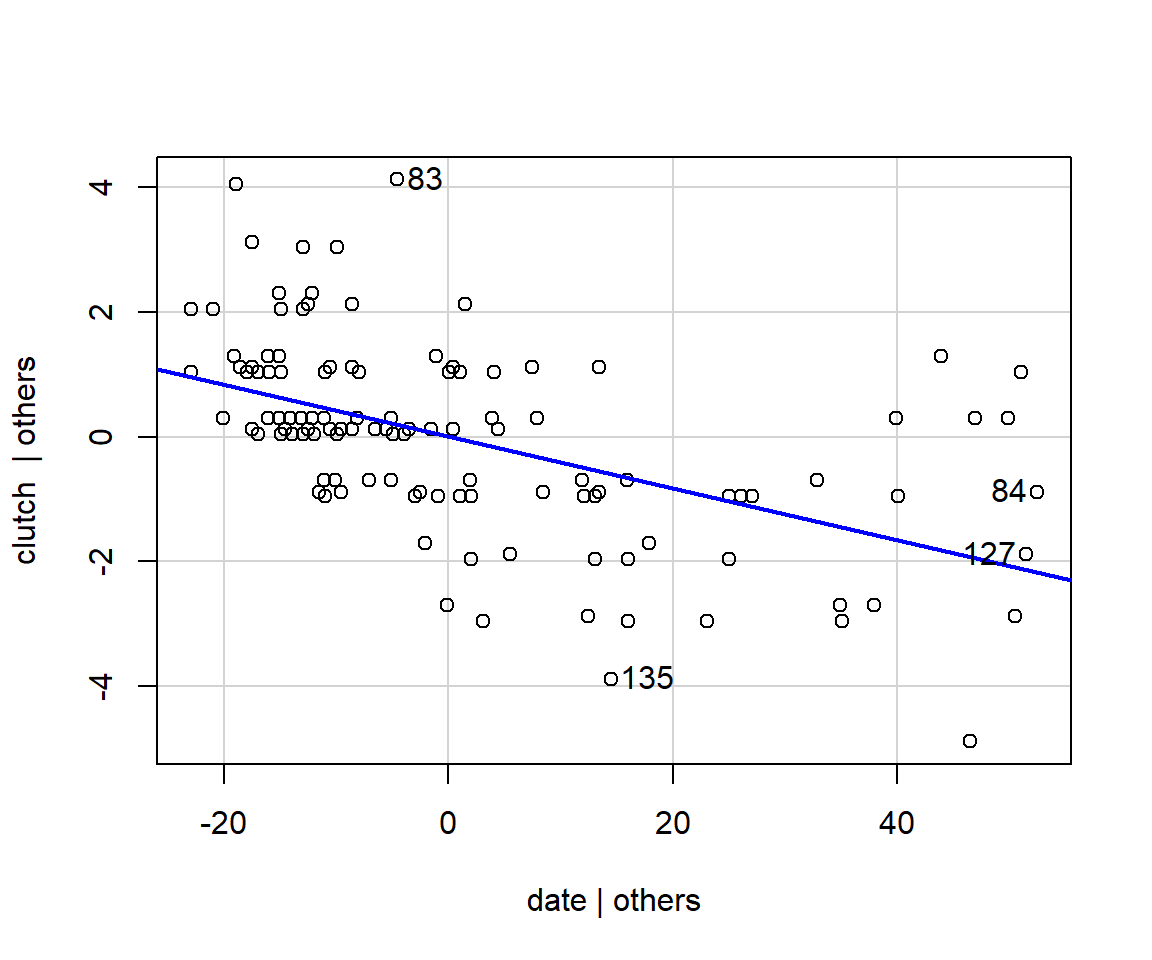
Added Variable Plots (for \(X_i\))
Regress \(Y\) against \(X_{-i}\) (i.e., all predictors except\(X_i\)), and obtain the residuals
Regressing \(X_i\) against all other predictors (\(X_{-i}\)) and obtain the residuals
Plot the residuals from [1] against the residuals from [2].
Plots the part of \(Y\) not explained by other predictors (i.e., \(X_{-i}\)) against the part of \(X_i\) not explained by the other predictors (\(X_{-i}\)).
Lets us visualize the effect of \(X_i\) after accounting for all other predictors.
car::avPlots(lm.fit1, terms ="date")
Shows the slope and the true scatter of points around the partial line in an analogous way to bi-variate plots in simple linear regression
Tells us about the importance of \(X_2\) (given everything else already in the model)
Can help with diagnosing non-linearities
Helps visualize influential points and outliers
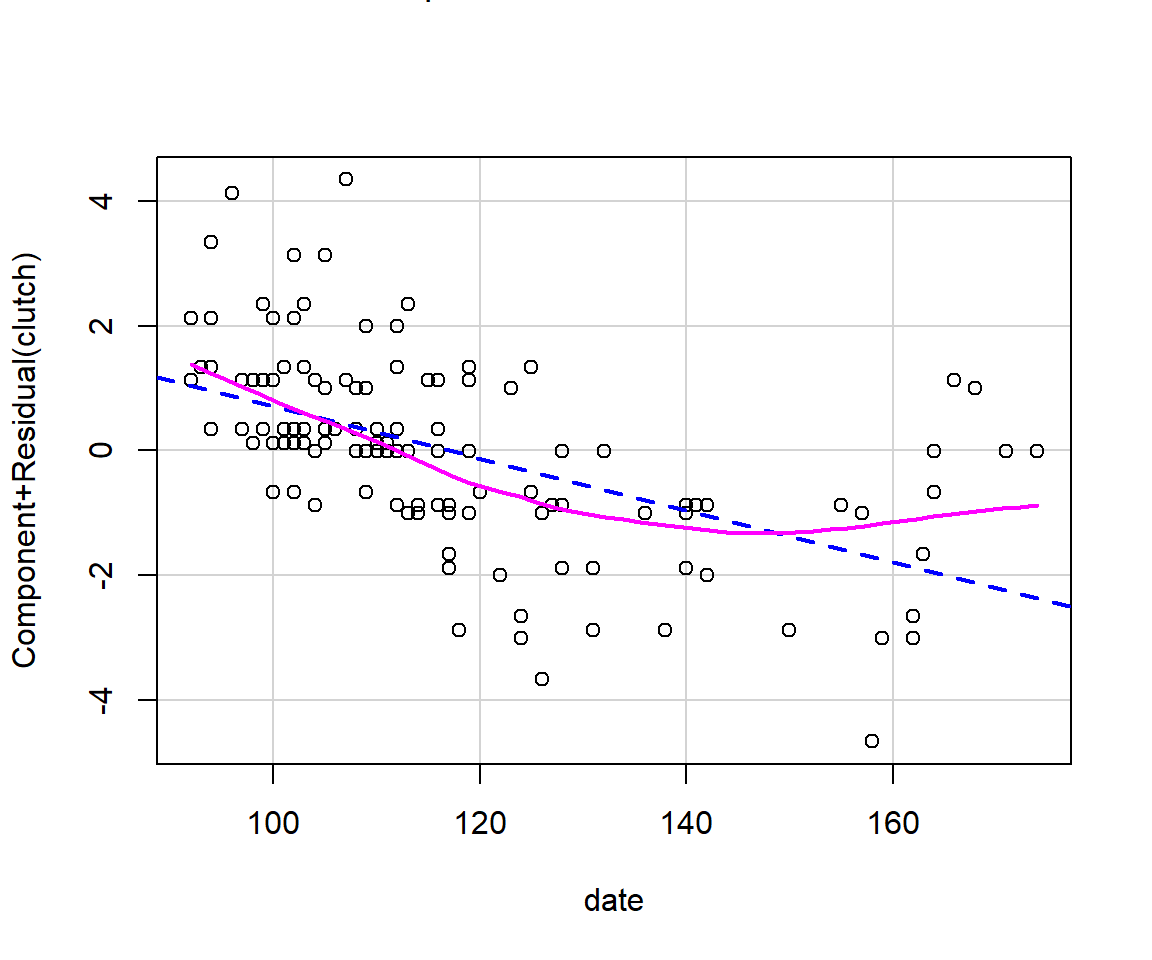
Component + residual plots or partial residual plot
Plots \(X_i\beta_i + \hat{\epsilon}_i\) versus \(X_i\).
Better for diagnosing non-linearities
X-axis depicts the scale of the focal variable (rather than the scale residuals)
Not as good at depicting the amount of variability explained by the predictor (given everything else in the model).
Easy to generalize to regression models with polynomials/splines and other types of regression models
We can plot adjusted means by varying a focal variable over its range of observed values, while holding all non-focal variables at constant values (e.g., at their means or modal values).
Depict \(\hat{\mu} |\)Year = 1998, Date = date for a range of date values.