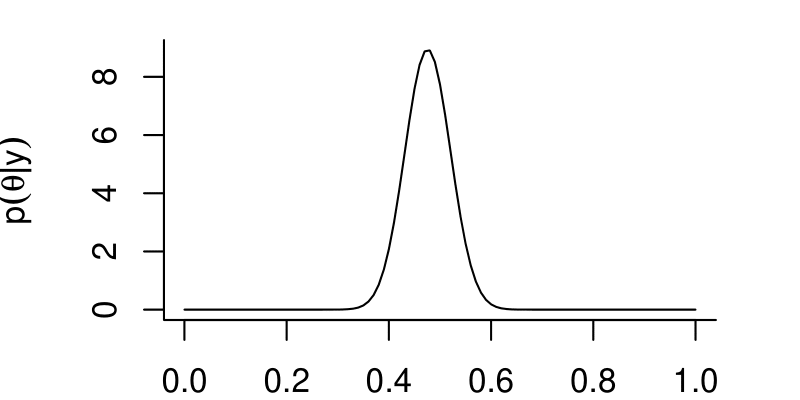
Consider two possible values of \(\theta\) = {\(\theta_1\) and \(\theta_2\)}. Without the denominator, we cannot evaluate \(p(\theta_1 | y)\) or \(p(\theta_2 | y)\).
We can, however, evaluate the relative likelihood of \(\theta_1\) and \(\theta_2\):
Initiate the Markov chain with an initial starting value, \(\theta_0\)
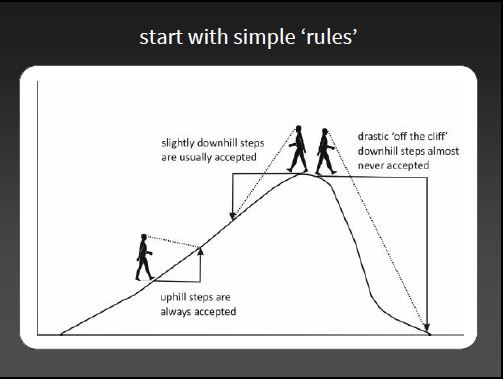
Generate a new, proposed, value of \(\theta\) from a symmetric distribution centered on \(\theta_0\) (e.g., \(\theta^{\prime}\) = rnorm(\(\theta_0\), mean =0, sd=1)).
Decide whether to accept or reject \(\theta^{\prime}\):
If R = \(\frac{p(\theta^{\prime} | y)}{p(\theta_0 | y)} > 1\): Accept and set \(\theta_1 = \theta^{\prime}\)!
If R \(<1\) accept \(\theta^{\prime}\) with probability = R. Otherwise (i.e., if reject), set \(\theta_1 = \theta_0\)
Back to step 2, and …
Continue to sample until:
The distribution of \(\theta_1, \theta_2, \ldots, \theta_M\) appears to have reached a steady state (i.e., reached convergence).
The MCMC sample, \(\theta_1, \theta_2, \ldots, \theta_M\) is sufficiently large to summarize \(p(\theta | data)\)
Convergence
There are no foolproof methods for detecting convergence. Some things that we can and will do:
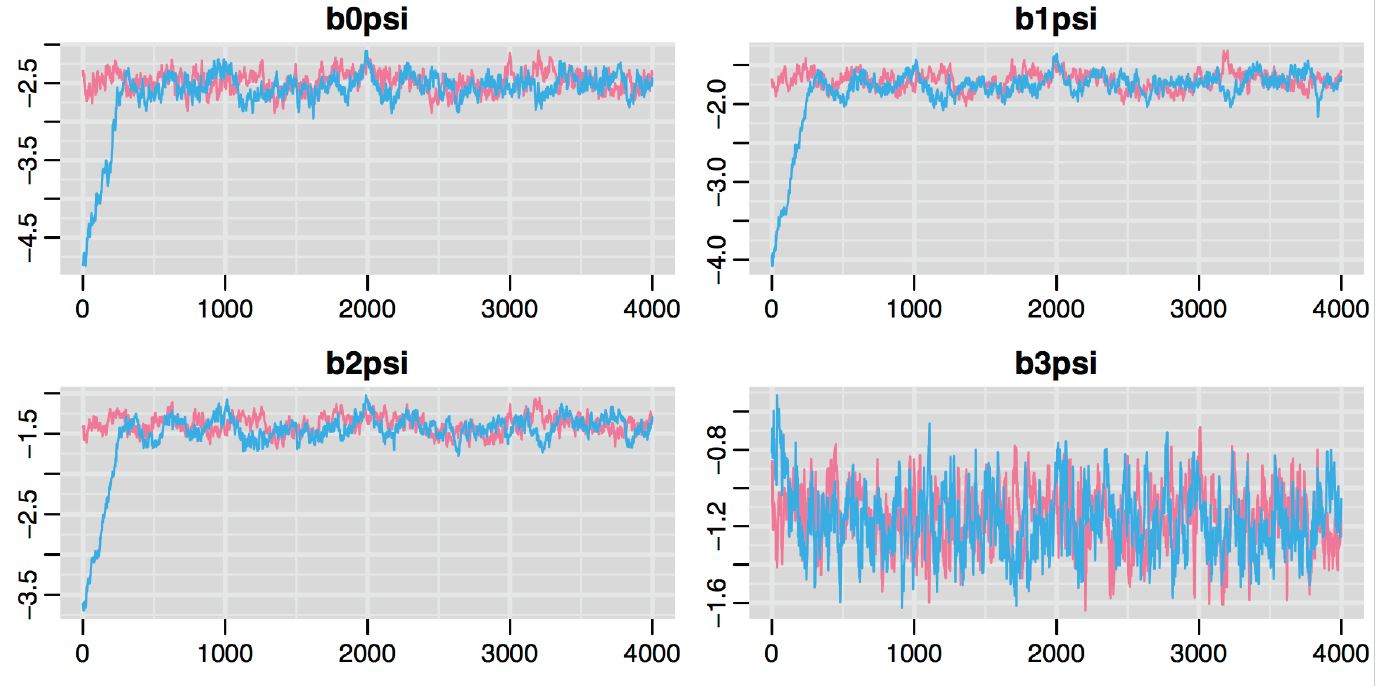
Run multiple chains (starting in different places) and see if they converge on similar distributions
Discard the first \(n_{burnin}\) iterations (where the sampler has not yet converged)
Calculate the Gelman-Rubin Statistic, Rhat = compares variance of between chains to within chains
Values near 1 suggest likely convergence
Should be less than 1.1 (general rule)
Details
With Metropolis or Metropolis-Hastings, need to consider how to generate good proposals
Other samplers may be more efficient (i.e., reach steady state quicker and better explore the distribution of \(p(\theta | data)\))
JAGS will attempt to determine how best to sample once we give it a likelihood and set of prior distributions (one for each parameter).
JAGS
Steps:
Specify prior distributions and the likelihood of the data.
Call JAGS from R to generate samples.
Evaluate whether or not we think the samples have converged in distribution to \(p(\theta | y)\)
Use our samples to characterize the posterior distribution, \(p(\theta | data)\)
JAGS and WinBugs represent a normal distribution as \(N(\mu, \tau = 1/\sigma^2)\), \(\tau\) is called the precision
Often best to form priors for \(\sigma\) (requires thinking about SD rather than 1/variance)
Where do these priors come from?
Good question. I tried to make sure:
the priors were dispersed enough to encompass all the likely values for the parameters
It is a good idea to check whether:
your posterior looks different from your prior (i.e., if it was “informed by the data”)
the posterior appears to have been constrained by your prior distribution
your results change if you use a different prior
JAGS
JAGS/BUGS (hereafter JAGS) code looks just like R code, but with some differences:
JAGS code is not executed (just defines the model)
Order does not matter (prior before likelihood, likelihood after prior, etc)
JAGS
There are 6 types of objects
Modeled data defined with a \(\sim\) (“distributed as”). For example y \(\sim\) followed by a probability distribution. The variable y here is the response in our regression model.
Unmodeled data: objects that are not assigned probability distributions. Examples include predictors, constants, and index variables.
Modeled parameters: these are given informative “priors” that themselves depend on parameters called hyperparameters. These are what a frequentist would call random effects. We won’t consider till later in the course.
Unmodeled parameters: these are given uninformative priors. [So in truth all parameters are modeled].
Derived quantities: these objects are typically defined with the assignment arrow, <-
Looping indexes: i, j, etc.
JAGS
Types of objects for JAW example
Modeled data = males, females
Unmodeled data = nmales, nfemales
Modeled parameters (none in this example)
Unmodeled parameters = mu.male, mu.female, sigma
Derived quantities = tau, mu.diff
Looping indexes: i (used twice)
JAGS Tips
Start simple, then build up.
Lots of good tricks and tips in the Appendix of Kery’s Introduction to WinBugs for Ecologists, especially: